

The Focus Blog

We've heard plenty by now. The forecasts, the warnings, the predictions and the advice around what the coming El Niño weather pattern could mean for farming. And while there is no doubt the season ahead could bring its challenges, most farmers have been here before. Droughts aren't new, and unfortunately, they won't be a one-off.
Farmers are used to operating under pressure, making tough calls and adapting when things don't go to plan. But with so much talk about what might be coming, it's worth stepping back from the forecasts for a moment and asking a more practical question: what can we do now to put ourselves in the strongest possible position?
The answer is easier than you would think, and it starts with having a strong plan.
It sounds simple, but having a clear, realistic plan in place can make a significant difference when conditions start to tighten. Often a farmer's plan lives in their head, and while it may be a good plan, it needs to be documented to get the most value from it.
Start by sitting down and looking at your farm business as it stands today. What does the season ahead look like? Be realistic about your expected income and expenses, your current stock numbers and condition, how much feed you're realistically likely to grow, and the production or sales targets you're working towards.
Be honest with yourself for this main budget. A plan is only useful if it reflects what is genuinely achievable, not just what we hope might happen.
A good place to start is by looking backwards. Reports such as the Farm Focus Trends report can help you review your farm's financial performance over the last five years, as well as an average across those years. This gives you a useful starting point, helping you understand your historical income, expenses and spending patterns before building your expectations for the season ahead.


Once you have a realistic main budget in place, it's time to start asking, 'What if?'
One of the most valuable things you can do is make a copy of your main budget and create a couple of alternative scenarios.
First, consider a worst-case scenario. Be deliberately pessimistic. What if interest rates go up? What if prices are lower than expected? What if you have higher farm expenses? What if the feed you grow is well below your usual expectations? What would that do to your cash position and the overall performance of your business?
Then create a more optimistic, best-case scenario. What if the season goes better than expected? What if prices hold up, feed production is reasonable and you get a decent run of weather? The tools are built into Farm Focus to quickly turn your main budget into these draft scenarios.
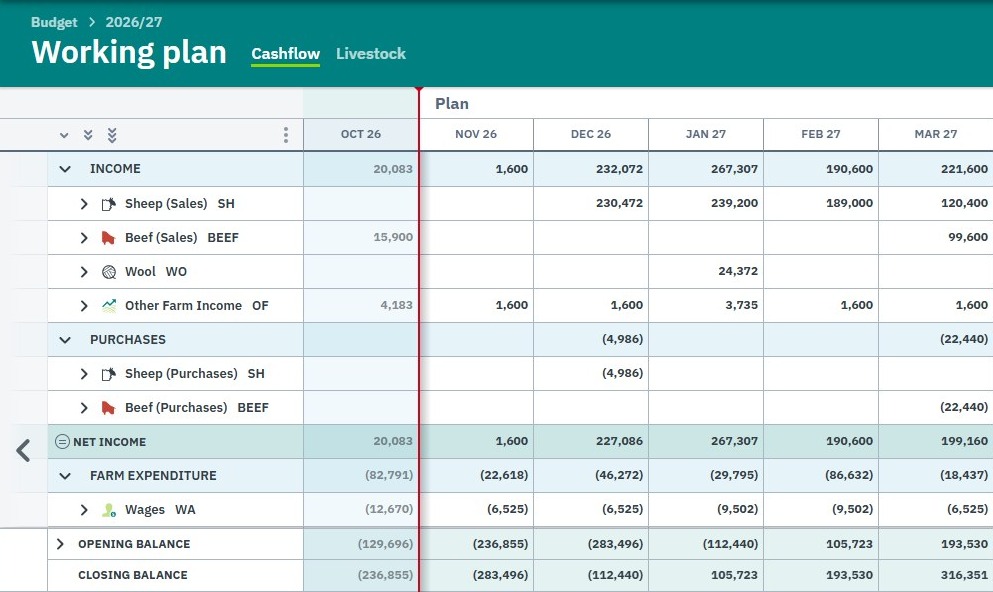
These scenarios aren't about predicting exactly what will happen. They're about understanding what could happen and, more importantly, what decisions you might need to make along the way.
Think about the triggers that would prompt a change in direction. It might be pasture covers, growth rates, stock weights, production levels or cash in the bank. At what point would you need to consider selling stock earlier, changing your stocking policy, buying in feed, reducing expenditure or adjusting your spending?
What are the options available to you, and how much time do you have to make those decisions?
Having these conversations with yourself now, while you have time to think things through and the headspace to be pragmatic, is far better than trying to make big decisions under pressure when feed is running short or the bank balance is looking uncomfortable.
When you can see the potential financial impact of different decisions in black and white, you're in a much stronger position to act early and with confidence.
Of course, even the best-laid plans don't always go to plan. Farming involves plenty of uncertainty, and we won't always get every decision right. But often, making an informed decision and committing to it is better than sitting on the fence and hoping things will improve.
Once you've had a go at putting your budget and scenarios together, bring in the people around you.
That might be your farm consultant, accountant or other trusted adviser who can offer a different perspective, challenge your thinking and help identify opportunities or risks you might have missed.
And bring your bank manager into the conversation.
One thing we know is that bank managers appreciate good-quality information, and like most of us, they don't particularly enjoy surprises.
If you can get them around the table early, share where you're at, talk through your thinking and give them an idea of the different scenarios you've considered, they're in a much better position to understand your business and support you if things get tough. You'll also get a gold star for having a plan and communicating it well.
That doesn't mean you need to have all the answers before you pick up the phone. In fact, it's often better to have those conversations while you're still working through the options.
Keep them updated as the season progresses, particularly if your position changes. Good communication and a shared understanding of what's happening in your business can make a real difference when you need support.
Farmers often have a pretty good gut feel for how things are tracking. They know their land, their stock and their business better than anyone. But getting that thinking documented means you can share it with others, test your assumptions and make decisions based on actual numbers rather than relying solely on how things feel at the time.
Getting a budget together for the first time can feel like a big job, particularly if it's not something you're used to doing regularly. But don't let that put you off.
Once you've made a start, the key is to keep coming back to it. Little and often is much more manageable than leaving everything until the end of the season or waiting until something goes wrong.
Update your actual income and expenses, review how things are tracking against your budget and adjust your forecasts as conditions change. Revisit your scenarios and see whether the assumptions you made are still realistic.
A budget isn't something you create once, file away and forget about. It's a working plan that should evolve alongside your business.
We often hear from farmers that the first time sitting down to work through a budget can be daunting. But once you're familiar with the process, it can become a genuinely rewarding part of running your farm business. You start to understand your numbers better, spot things earlier and feel more in control of the decisions ahead.
It's easy to spend most of your time outside making sure stock are fed, fences are up and everything is ticking along. Those things are obviously important, but the time you spend in the office working on the business is just as valuable.
For many farmers, budgeting and paperwork tend to happen in the evenings, once the day's work is done. That's understandable given how busy farming can be, but it's worth considering whether some of that time could be built into your working day instead.
Time spent understanding your numbers, reviewing your position and planning ahead is not time away from farming. It's an important part of running a successful farm business.
And while you're making a plan for the farm, don't forget to make one for yourself and the people around you, too. Looking after yourself and your team is every bit as important as looking after the farm.
There is plenty in farming that we simply can't control. The weather is an obvious one, and no amount of planning will make it rain when we need it to.
But there is plenty we can control. So, rather than spending too much time worrying about what the coming season might bring, use this time to get prepared.
Get your budget sorted. Put some alternative scenarios together. Talk to your trusted team and keep the conversation going as the season progresses.
And if you're not sure where to start, don't feel you have to do it alone. The Farm Focus team, based in Masterton, is always happy to help. There is plenty of training and support available to help you get familiar with budgeting, understand your numbers and make the most of the tools at your fingertips.
We can't control the weather, but we can control how prepared we are for it.
Make a plan, get it on paper and give yourself the best possible chance of staying one step ahead.
New to Farm Focus? Get started free for 30 days and build your first budget, with our Masterton team on hand to help.
Already on Farm Focus? Learn more about plans and budgets, including your working plan and setting up draft scenarios.